Statistical Methods for Replication Assessment

Replicability Crisis in Science?

Filippo Gambarota
Gianmarco Altoè

18-22 September 2023

What is considered a successful or unsuccessful replication?

Some (random) concepts

Some (random) concepts

Credibility of scientific claims is established with evidence for their replicability using new data (Nosek & Errington, 2020)

Replication is repeating a study’s procedure and observing whether the prior finding recurs (Jeffreys, 1973)

Replication is a study for which any outcome would be considered diagnostic evidence about a claim from prior research (Nosek & Errington, 2020).

Difficulty in drawing conclusions from replications

Replication is often intended as conditioned to the original result. The original result could be a false positive or a biased result. Also the replication attempt could be a false positive or a false negative (Nosek & Errington, 2020).

To be a replication, two things must be true. Outcomes consistent with a prior claim would increase confidence in the claim, and outcomes inconsistent with a prior claim would decrease confidence in the claim (Nosek & Errington, 2020).

This is somehow similar with a Bayesian reasoning where evidence about a phenomenon is updated after collecting more data.

Exact and Conceptual replications

Exact replications are commonly considered as the gold-standard but in practice (especially in Social Sciences, Psychology, etc.) are rare.

Let’s imagine, an original study \(y_{or}\) finding a result.

  • Replication \(y_{rep}\) with the exact same method find the same result. Replication or not?
  • Replication \(y_{rep}\) with a similar method find the same result. Replication or not?
  • Replication \(y_{rep}\) with similar method did not find the same result. Replication or not?

Direct and Conceptual replications (S. Schmidt, 2009)

A direct replication is defined as the repetition of an experimental procedure.

A conceptual replication is defined as testing the same hypothesis with different methods.

Exact replications are (often) impossible (S. Schmidt, 2009)

Let’s imagine an extreme example: testing the physiological reaction to arousing situation:

  • The original study: Experiment with prehistoric reacting to an arousing stimulus
  • The actual replication: It is possible to create the exact situation? Some phenomenon changes overtime, especially people-related phenomenon

Exact replication is often not feasible. Even using the same experimental setup (direct replication) does not assure that we are studying the same phenomenon.

As Exact as possible…

Even when an experiment use almost the same setup of the original study there is a source of unknown uncertainty. Which is the impact of a slightly change in the experimental setup on the actual result?

  • A study on the human visual system: presenting stimuli on different monitors –> small change with a huge impact
  • A study on consumer behavior: participant answering question using a smartphone or a computer –> small but (maybe) irrelevant change

How to evaluate the actual impact?

What we are going to do?

What we are (not) going to do?

  • I will not present a strictly theoretical and philosophical approach to replication (what is a replication?, what is the most appropriate definition?, etc.). But we can discuss it together 😄!
  • According to the replication definitions and problems, we will explore some statistical methods to evaluate a replication success

Overall model and notation

Overall model and notation

For the purpose of notation and simplicity we can define a meta-analytical-based replication model (Hedges & Schauer, 2019c; Schauer, 2022; Schauer & Hedges, 2021)

\[ y_i = \mu_{\theta} + \delta_i + \epsilon_i \]

\[ \delta_i \sim \mathcal{N}(0, \tau^2) \]

\[ \epsilon_i \sim \mathcal{N}(0, \sigma^2_i) \]

Overall model and notation

  • Thus each study \(i\) out of the number of studies \(k\).
  • \(\mu_{\theta}\) is the real average effect
  • \(\mu_{\theta} + \delta_i\) is the real effect of each study where \(\delta_i\) is the study-specific deviation from the overall effect
  • \(\tau^2\) is the real variance among different studies. When \(\tau^2 = 0\) there is no variability among studies
  • \(\epsilon_i\) are the sampling errors that depends on \(\sigma^2_i\), the sampling variability of each study (i.e., how imprecise is the estimation). \(\sigma^2_i\) (that depends on the study variance and sample size) determine how precise is the estimation of each \(\mu_{\theta} + \delta_i\).
  • With \(\theta_i\) we define the study specific effect i.e. \(\mu_{\theta} + \delta_i\) for simplicity
  • The observed effect \(y_i\) is an estimate of \(\theta_i\)
  • We define \(\theta_{orig}\) (or \(\theta_1\)) as the original study and \(\theta_{rep_i}\) (with \(i\) from 2 to \(k\)) as the replication studies

Overall model and notation

For the examples we are going to simulate (unstandardized) effect sizes (see Slide “Extra - Simulating Meta-Analysis” of the meta-analysis workshop). Basically:

\[ \Delta = \overline{X_1} - \overline{X_2} \]

\[ SE_{\Delta} = \sqrt{\frac{s^2_1}{n_1} + \frac{s^2_2}{n_2}} \]

With \(X_{1_j} \sim \mathcal{N}(0, 1)\) and \(X_{2_j} \sim \mathcal{N}(\Delta, 1)\)

continue…

Overall model and notation

Thus our observed effect sizes \(y_i\) is sampled from: \[ y_i \sim \mathcal{N}(\mu_\theta, \tau^2 + \frac{1}{n_1} + \frac{1}{n_2}) \]

Where \(\frac{1}{n_1} + \frac{1}{n_2}\) is the sampling variability (\(\sigma^2_i\)).

The sampling variances are sampled from:

\[ \sigma_i^2 \sim \frac{\chi^2_{n_1 + n_2 - 2}}{n_1 + n_2 - 2} (\frac{1}{n_1} + \frac{1}{n_2}) \]

Overall model and notation

Everything is implemented into the sim_studies() function:

sim_studies <- function(k, theta, tau2, n0, n1, summary = FALSE){
  yi <- rnorm(k, theta, sqrt(tau2 + 1/n0 + 1/n1))
  vi <- (rchisq(k, n0 + n1 - 2) / (n0 + n1 - 2)) * (1/n0 + 1/n1)
  out <- data.frame(yi, vi, sei = sqrt(vi))
  if(summary){
    out <- summary_es(out)
  }
  return(out)
}
sim_studies(k = 10, theta = 0.5, tau2 = 0.1, n0 = 30, n1 = 30)
             yi         vi       sei
1  -0.448917264 0.05470588 0.2338929
2   0.320404862 0.04946823 0.2224146
3  -0.005809151 0.06306609 0.2511296
4  -0.119407165 0.06343033 0.2518538
5   0.020454832 0.08837627 0.2972815
6   0.602803505 0.10279809 0.3206214
7   0.990654574 0.05977646 0.2444923
8   0.330797921 0.06472821 0.2544174
9  -0.398616671 0.05947599 0.2438770
10  0.241340611 0.06802436 0.2608148

Exact vs Approximate replication

This distinction (see Brandt et al., 2014 for a different terminology) refers to parameters \(\theta_i\). With exact are considering a case where:

\[ \theta_1 = \theta_2 = \theta_3, \dots, \theta_k \]

Thus the true parameters of \(k\) replication studies are the same. Thus the variability among true effects \(\tau^2 = 0\).

Similarly, due to (often not controllable) differences among experiments (i.e., lab, location, sample, etc.) we could expect a certain degree of variability \(\tau^2\). In other terms \(\tau^2 < \tau^2_0\) where \(\tau^2_0\) is the maximum variability (that need to be defined). In this way studies are replicating:

\[ \theta_i \sim \mathcal{N}(\mu_\theta, \tau^2_0) \]

Types of agreement

Coarsely, we can define a replication success when two or more studies obtain the “same” result. The definion of sameness it is crucial:

  • same sign or direction: two studies (original and replication) evaluating the efficacy of a treatment have a positive effect \(sign(\theta_1) = sign(\theta_2)\) where \(sign\) is the sign function.
  • same magnitude: two studies (original and replication) evaluating the efficacy of a treatment have the same effect in terms \(|\theta_1 - \theta_2| = 0\) or similar up to a tolerance factor \(|\theta_1 - \theta_2| < \gamma\) where \(\gamma\) is the maximum difference considered as null.

The different methods that we are going to see are focused on a specific type of aggreement. For example, we could consider \(\theta_1 = 3x\) and \(\theta_2 = x\) to have the same sign but the replication study is on a completely different scale. Is this considered a successful replication?

Falsification vs Consistency

This refers to how the replication setup is formulated. With \(k = 2\) studies where \(k_1\) is the original study and \(k_2\) is the replication we have a one-to-one setup. In this setup we compare the replication with the original and according to the chosen method and expectation we conclude if \(k_1\) has been replicated or not.

When \(k > 2\) we could collapse the replication studies into a single value (e.g., using a meta-analysis method) and compare the results using a one-to-one or we can use a method for one-to-many designs.

Regardless the method, falsification approaches compared the original with the replicate(s) obtaining a yes-no answer or a continuous result. On the other side consistency methods are focused on evaluating the degree of similarity (i.e., consistency) among all studies.

The big picture

Statistical Methods

Statistical Methods, disclaimer (Schauer & Hedges, 2021)

  • There are no unique methods to assess replication from a statistical point of view
  • For available statistical methods, statistical properties (e.g., type-1 error rate, power, bias, etc.) are not always known or extensively examined
  • Different methods answers to the same question or to different replication definitions

Frequentists Methods

Vote Counting based on significance or direction

The simplest method is called vote counting (Hedges & Olkin, 1980; Valentine et al., 2011). A replication attempt \(\theta_{rep}\) is considered successful if the result has the same direction of the original study \(\theta_{orig}\) and it is statistically significant i.e., \(p_{\theta_{rep}} \leq \alpha\). Similarly we can count the number of replication with the same sign as the original study.

  • Easy to understand, communicate and compute
  • Did not consider the size of the effect
  • Depends on the power of \(\theta_{rep}\)

Example with simulated data

Let’s simulate an exact replication:

## original study
n_orig <- 30
theta_orig <- theta_from_z(2, n_orig)

orig <- data.frame(
  yi = theta_orig,
  vi = 4/(n_orig*2)
)

orig$sei <- sqrt(orig$vi)
orig <- summary_es(orig)

orig
         yi         vi       sei zi       pval      ci.lb    ci.ub
1 0.5163978 0.06666667 0.2581989  2 0.04550026 0.01033725 1.022458
## replications

k <- 10
reps <- sim_studies(k = k, theta = theta_orig, tau2 = 0, n_orig, n_orig, summary = TRUE)

head(reps)
         yi         vi       sei        zi         pval       ci.lb     ci.ub
1 0.4106045 0.04883118 0.2209778 1.8581255 0.0631511926 -0.02250404 0.8437130
2 0.5925199 0.07018358 0.2649218 2.2365837 0.0253135619  0.07328260 1.1117571
3 0.4861510 0.07065960 0.2658187 1.8288815 0.0674173580 -0.03484417 1.0071461
4 0.2306294 0.08292434 0.2879659 0.8008913 0.4231945639 -0.33377336 0.7950321
5 0.6164282 0.06172083 0.2484368 2.4812278 0.0130930662  0.12950111 1.1033554
6 0.7851106 0.04562832 0.2136079 3.6754762 0.0002374062  0.36644691 1.2037744

Example with simulated data

Let’s compute the proportions of replication studies are statistically significant:

mean(reps$pval <= 0.05)
[1] 0.6

Let’s compute the proportions of replication studies with the same sign as the original:

mean(sign(orig$yi) == sign(reps$yi))
[1] 1

We could also perform some statistical tests. See Bushman & Wang (2009) and Hedges & Olkin (1980) for vote-counting methods in meta-analysis.

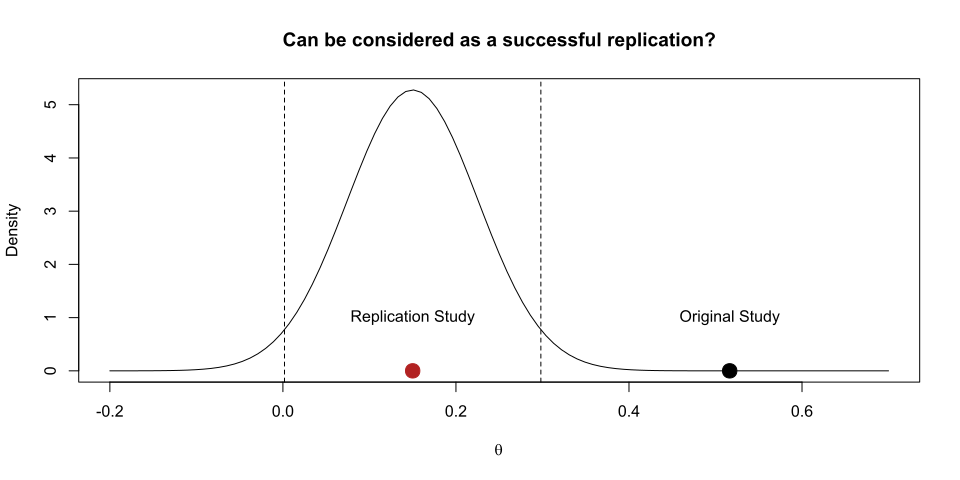
Vote Counting, extreme example

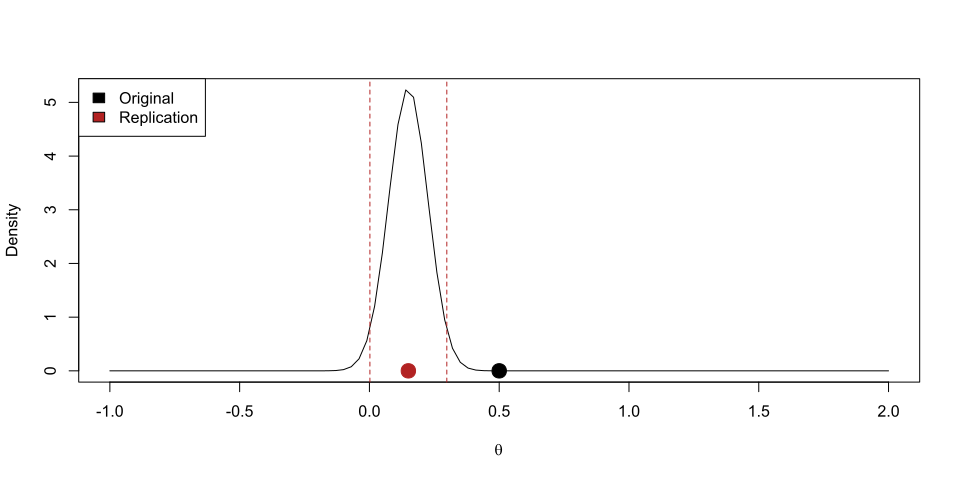
Let’s imagine an original experiment with \(n_{orig} = 30\) and \(\hat \theta_{orig} = 0.5\) that is statistically significant \(p \approx 0.045\). Now a direct replication (thus assuming \(\tau^2 = 0\)) study with \(n_{rep} = 350\) found \(\hat \theta_{rep_1} = 0.15\), that is statistically significant \(p\approx 0.047\).
Confidence Interval, replication within original

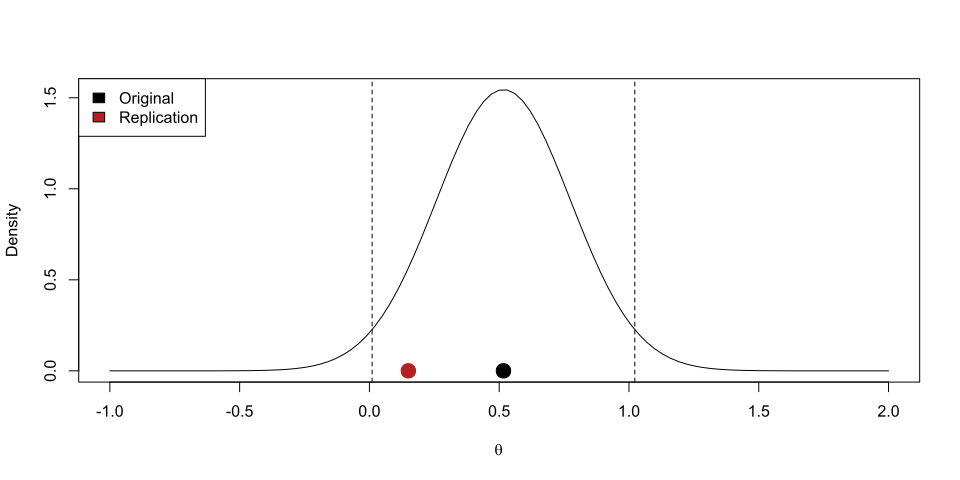
Another approach check if the replication attempt \(\theta_{rep}\) is contained in the % confidence interval of the original study \(\theta_{orig}\). Formally:

\[ \theta_{orig} - \Phi(\alpha/2) \sqrt{\sigma^2_{orig}} < \theta_{rep} < \theta_{orig} + \Phi(\alpha/2) \sqrt{\sigma^2_{orig}} \]

Where \(\Phi\) is the cumulative standard normal distribution, \(\alpha\) is the type-1 error rate.

  • Take into account the size of the effect and the precision of \(\theta_{orig}\)
  • The original study is assumed to be a reliable estimation
  • No extension for many-to-one designs
  • Low precise original studies lead to higher success rate
Confidence Interval, replication within original

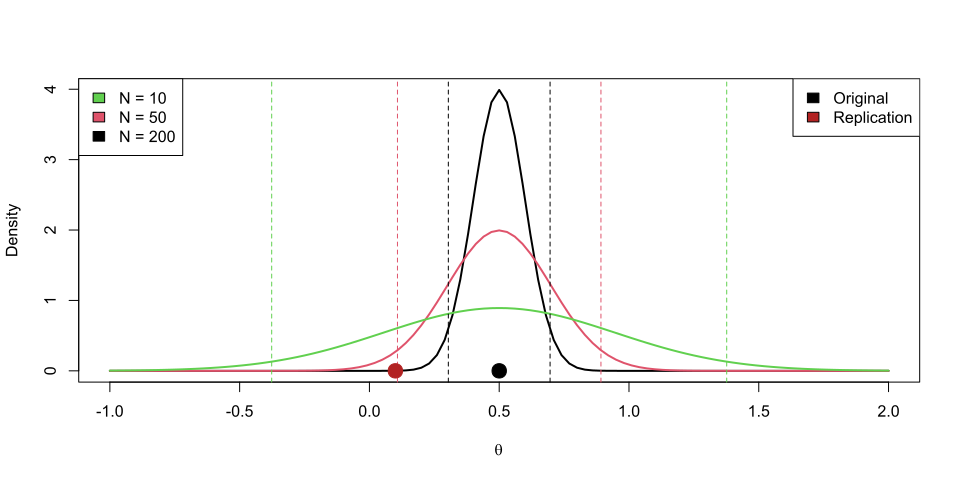
One potential problem of this method regards that low precise original studies are “easier” to replicate due to larger confidence intervals.
Confidence Interval, original within replication

The same approach can be applied checking if the original effect size is contained within the replication confidence interval. Clearly these methods depends on the precision of studies. Formally:

\[ \theta_{rep} - \Phi(\alpha/2) \sqrt{\sigma_{rep}^2} < \theta_{orig} < \theta_{rep} + \Phi(\alpha/2) \sqrt{\sigma_{rep}^2} \]

The method has the same pros and cons of the previous approach. One advantage is that usually replication studies are more precise (higher sample size) thus the parameter and the % CI is more reliable.
Prediction interval (PI), what to expect from a replication

One problem of the previous approaches is taking into account only the uncertainty of the original or the replication study. Patil et al. (2016) and Spence & Stanley (2016) proposed a method to take into account both sources of uncertainty.

If the original and replication studies comes from the same population, the sampling distribution of the difference is centered on 0 with a certain standard error \(\theta_{orig} - \theta_{rep_0} \sim \mathcal{N}\left( 0, \sqrt{\sigma^2_{\hat \theta_{orig} - \hat \theta_{rep}}} \right)\) (subscript \(0\) to indicate that is expected to be sampled from the same population as \(\theta_{orig}\))

\[ \hat \theta_{orig} \pm z_{95\%} \sqrt{\sigma^2_{\theta_{orig} - \theta_{rep}}} \]

If factors other than standard error influence the replication result, \(\theta_{rep_0}\) is not expected to be contained within the 95% prediction interval.

Prediction interval (PI), what to expect from a replication

In the case of a unstandardized mean difference we can compute the prediction interval as:

\[ \sqrt{\sigma^2_{\epsilon_{\hat \theta_{orig} - \hat \theta_{rep_0}}}} = \sqrt{\left( \frac{\hat \sigma^2_{o1}}{n_{o1}} +\frac{\hat \sigma^2_{o2}}{n_{o2}}\right) + \left(\frac{\hat \sigma^2_{o1}}{n_{r1}} + \frac{\hat\sigma^2_{o2}}{n_{r2}}\right)} \]

The first term is just the standard error of the difference between the two groups in the original study and the second term is the standard error of the hypothetical replication study assuming the same standard deviation of the original but a different \(n\).

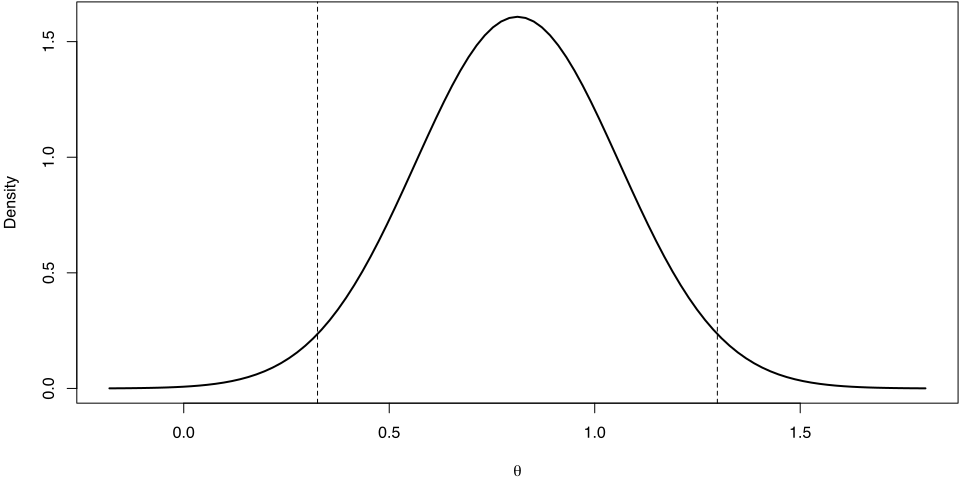
In this way we estimate an interval where, combining sampling variance from both studies and assuming that they comes from the same population, the replication should fall.

Prediction interval (PI), what to expect from a replication

set.seed(2025)

o1 <- rnorm(50, 0.5, 1) # group 1
o2 <- rnorm(50, 0, 1) # group 2
od <- mean(o1) - mean(o2) # effect size
se_o <- sqrt(var(o1)/50 + var(o2)/50) # standard error of the difference

n_r <- 100 # sample size replication

se_o_r <- sqrt(se_o^2 + (var(o1)/100 + var(o2)/100))

od + qnorm(c(0.025, 0.975)) * se_o_r
[1] 0.325520 1.298378
Code
par(mar = c(4, 4, 0.1, 0.1))  
curve(dnorm(x, od, se_o_r), od - se_o_r*4, od + se_o_r*4, lwd = 2, xlab = latex2exp::TeX("$\\theta$"), ylab = "Density")
abline(v = od + qnorm(c(0.025, 0.975)) * se_o_r, lty = "dashed")

  • Take into account uncertainty of both studies
  • We can plan a replication using the standard deviation of the original study and the expected sample size
  • Low precise original studies lead to wide PI. For a replication study is difficult to fall outside the PI
  • Mainly for one-to-one replications design

Mathur & VanderWeele (2020) \(p_{orig}\)

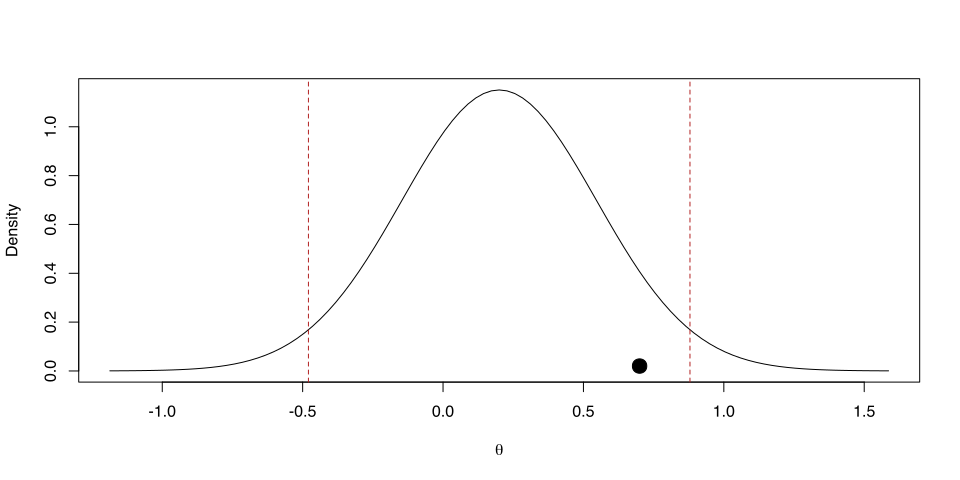
Mathur & VanderWeele (2020) proposed a new method based on the prediction interval to calculate a p value \(p_{orig}\) representing the probability that \(\theta_{orig}\) is consistent with the replications. This method is suited for many-to-one replication designs. Formally:

\[ P_{orig} = 2 \left[ 1 - \Phi \left( \frac{|\hat \theta_{orig} - \hat \mu_{\theta_{rep}}|}{\sqrt{\hat \tau^2 + \sigma^2_{orig} + \hat{SE}^2_{\hat \mu_{\theta_{rep}}}}} \right) \right] \]

  • \(\mu_{\theta_{rep}}\) is the pooled (i.e., meta-analytic) estimation of the \(k\) replications
  • \(\tau^2\) is the variance among replications

It is interpreted as the probability that \(\theta_{orig}\) is equal or more extreme that what observed. A very low \(p_{orig}\) suggest that the original study is inconsistent with replications.

  • Suited for many-to-one designs
  • We take into account all sources of uncertainty
  • We have a p-value

The code is implemented in the Replicate and MetaUtility R packages:

tau2 <- 0.05
theta_rep <- 0.2
theta_orig <- 0.7

n_orig <- 30
n_rep <- 100
k <- 20

replications <- sim_studies(k, theta_rep, tau2, n_rep, n_rep)
original <- sim_studies(1, theta_orig, 0, n_orig, n_orig)

fit_rep <- metafor::rma(yi, vi, data = replications) # random-effects meta-analysis

Replicate::p_orig(original$yi, original$vi, fit_rep$b[[1]], fit_rep$tau2, fit_rep$se^2)
[1] 0.5563241
Code
# standard errors assuming same n and variance 1
se_orig <- sqrt(4/(n_orig * 2))
se_rep <- sqrt(4/(n_rep * 2))
se_theta_rep <- sqrt(1/((1/(se_rep^2 + tau2)) * k)) # standard error of the random-effects estimate

sep <- sqrt(tau2 + se_orig^2 + se_theta_rep^2) # z of p-orig denominator

curve(dnorm(x, theta_rep, sep), theta_rep - 4*sep, theta_rep + 4*sep, ylab = "Density", xlab = latex2exp::TeX("\\theta"))
points(theta_orig, 0.02, pch = 19, cex = 2)
abline(v = qnorm(c(0.025, 0.975), theta_rep, sep), lty = "dashed", col = "firebrick")
Mathur & VanderWeele (2020) \(\hat P_{> 0}\)

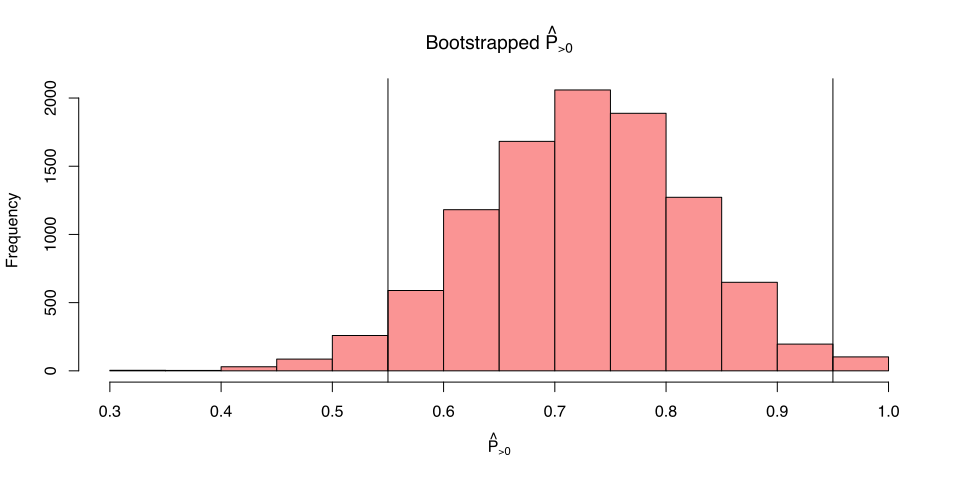
Another related metric is the \(\hat P_{> 0}\), representing the proportion of replications following the same direction as the original effect. Before simply computing the proportions we need to adjust the estimated \(\theta_{rep_i}\) with a shrinkage factor:

\[ \tilde{\theta}_{rep_i} = (\theta_{rep_i} - \mu_{\theta_{rep_i}}) \sqrt{\frac{\hat \tau^2}{\hat \tau^2 + v_{rep_i}}} \]

This method is somehow similar to the vote counting but we are adjusting the effects taking into account \(\tau^2\).

# compute calibrated estimation for the replications
# use restricted maximum likelihood to estimate tau2 under the hood
theta_sh <- MetaUtility::calib_ests(replications$yi, replications$sei, method = "REML")
mean(theta_sh > 0)
[1] 0.75

The authors suggest a bootstrapping approach for making inference on \(\hat P_{> 0}\)

nboot <- 1e4
theta_boot <- matrix(0, nrow = nboot, ncol = k)

for(i in 1:nboot){
  idx <- sample(1:nrow(replications), nrow(replications), replace = TRUE)
  replications_boot <- replications[idx, ]
  theta_cal <- MetaUtility::calib_ests(replications_boot$yi, 
                                       replications_boot$sei, 
                                       method = "REML")
  theta_boot[i, ] <- theta_cal
}

# calculate
p_greater_boot <- apply(theta_boot, 1, function(x) mean(x > 0))
Mathur & VanderWeele (2020) \(\hat P_{\gtrless q*}\)

Instead of using 0 as threshold, we can use meaningful effect size to be considered as low but different from 0. \(\hat P_{\gtrless q*}\) is the proportion of (calibrated) replications greater or lower than the \(q*\) value. This framework is similar to equivalence and minimum effect size testing (Lakens et al., 2018).

q <- 0.2 # minimum non zero effect

fit <- metafor::rma(yi, vi, data = replications)

# see ?MetaUtility::prop_stronger
MetaUtility::prop_stronger(q = q,
                           M = fit$b[[1]],
                           t2 = fit$tau2,
                           tail = "above",
                           estimate.method = "calibrated",
                           ci.method = "calibrated",
                           dat = replications,
                           yi.name = "yi",
                           vi.name = "vi")
   est        se  lo   hi  bt.mn shapiro.pval
1 0.35 0.1137901 0.1 0.55 0.3573    0.5224829

Combining original and replications

Another approach is to combine the original and replication results (both one-to-one and many-to-one) using a meta-analysis model. Then we can test if the pooled estimate is different from 0 or another meaningful value.

  • Use all the available information, especially when fitting a random-effects model
  • Take into account the precision by inverse-variance weighting
  • Did not consider the publication bias
  • For one-to-one designs only a fixed-effects model can be used
# fixed-effects
fit_fixed <- rma(yi, vi, method = "FE")
summary(fit_fixed)

Fixed-Effects Model (k = 20)

  logLik  deviance       AIC       BIC      AICc   
 20.7415   -0.0000  -39.4829  -38.4872  -39.2607   

I^2 (total heterogeneity / total variability):   0.00%
H^2 (total variability / sampling variability):  0.00

Test for Heterogeneity:
Q(df = 19) = 0.0000, p-val = 1.0000

Model Results:

estimate      se    zval    pval   ci.lb   ci.ub      
  0.2000  0.0316  6.3246  <.0001  0.1380  0.2620  *** 


---
Signif. codes:  0 '***' 0.001 '**' 0.01 '*' 0.05 '.' 0.1 ' ' 1
# fixed-effects
fit_random <- rma(yi, vi, method = "REML")
summary(fit_random)

Random-Effects Model (k = 20; tau^2 estimator: REML)

  logLik  deviance       AIC       BIC      AICc   
 19.7044  -39.4088  -35.4088  -33.5199  -34.6588   

tau^2 (estimated amount of total heterogeneity): 0 (SE = 0.0065)
tau (square root of estimated tau^2 value):      0
I^2 (total heterogeneity / total variability):   0.00%
H^2 (total variability / sampling variability):  1.00

Test for Heterogeneity:
Q(df = 19) = 0.0000, p-val = 1.0000

Model Results:

estimate      se    zval    pval   ci.lb   ci.ub      
  0.2000  0.0316  6.3246  <.0001  0.1380  0.2620  *** 

---

Signif. codes:  0 '***' 0.001 '**' 0.01 '*' 0.05 '.' 0.1 ' ' 1

The previous approach can be also implemented combining replications into a single effect and then compare the original with the combined replication study.

This is similar to using the CI or PI approaches but the replication effect will probably by very precise due to pooling multiple studies.

Q Statistics

An interesting proposal is using the Q statistics (Hedges & Schauer, 2019a, 2019b, 2019c, 2021; Schauer, 2022; Schauer & Hedges, 2020; Schauer & Hedges, 2021), commonly used in meta-analysis to assess the presence of heterogeneity. Formally:

\[ Q = \sum_{i = 1}^{k} \frac{(\theta_i - \bar \theta_w)^2}{\sigma^2_i} \]

Where \(\bar \theta_w\) is the inverse-variance weighted average (i.g., fixed-effect model). The Q statistics is essentially a weighted sum of squares. Under the null hypothesis where all studies are equal \(\theta_1 = \theta_2, ... = \theta_i\) the Q statistics has a \(\chi^2\) distribution with \(k - 1\) degrees of freedom. Under the alternative hypothesis the distribution is a non-central \(\chi^2\) with non centrality parameter \(\lambda\). The expected value of the \(Q\) is \(E(Q) = v + \lambda\), where \(v\) are the degrees of freedom.

Q Statistics

Hedges & Schauer proposed to use the Q statistics to evaluate the consistency of a series of replications:

  • In case of exact replication, \(\lambda = 0\) because \(\theta_1 = \theta_2, ... = \theta_k\).
  • In case of approximate replication, \(\lambda < \lambda_0\) where \(\lambda_0\) is the maximum value considered as equal to null (i.e., 0).

This approach is testing the consistency (i.e., homogeneity) of replications. A successful replication should minimize the heterogeneity and the presence of a significant Q statistics should bring evidence for not replicating the effect1.

Q Statistics

The method has been expanded and formalized in several papers with different objectives:

  • to cover different replications setup (burden of proof on replicating vs non-replicating, many-to-one and one-to-one, etc.)
  • interpret and choose the \(\lambda\) parameter given that is the core of the approach
  • evaluating the power and statistical properties under different replication scenarios
  • the standard implementation put the burden of proof on non-replication. Thus \(H_0\) is that studies replicates. They provided also a series of tests with the opposite formulation.

Q Statistics

In the case of evaluating an exact replication we can use the Qrep() function that simply calculate the p-value based on the Q sampling distribution.

Qrep <- function(yi, vi, lambda0 = 0, alpha = 0.05){
  fit <- metafor::rma(yi, vi)
  k <- fit$k
  Q <- fit$QE
  df <- k - 1
  Qp <- pchisq(Q, df = df, ncp = lambda0, lower.tail = FALSE)
  pval <- ifelse(Qp < 0.001, "p < 0.001", sprintf("p = %.3f", Qp))
  lambda <- Q - df
  res <- list(Q = Q, lambda = lambda, pval = Qp, df = df, k = k, alpha = alpha, lambda0 = lambda0)
  H0 <- ifelse(lambda0 != 0, paste("H0: lambda <", lambda0), "H0: lambda = 0")
  title <- ifelse(lambda0 != 0, "Q test for Approximate Replication", "Q test for Exact Replication")
  cli::cli_rule()
  cat(cli::col_blue(cli::style_bold(title)), "\n\n")
  cat(sprintf("Q = %.3f (df = %s), lambda = %.3f, %s", res$Q, res$df, lambda, pval), "\n")
  cat(H0, "\n")
  cli::cli_rule()
  class(res) <- "Qrep"
  invisible(res)
}
Q test for Exact Replication 

Q = 367.321 (df = 99), lambda = 268.321, p < 0.001 
H0: lambda = 0 
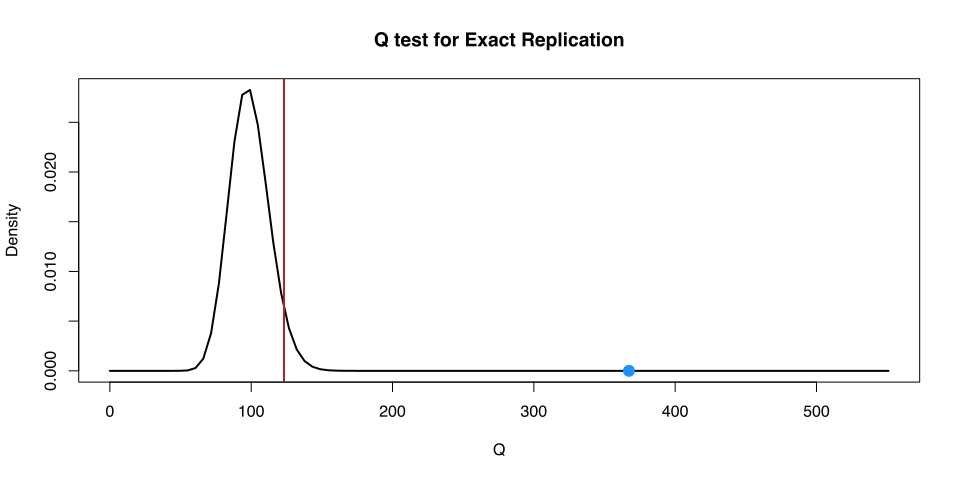
Qres <- Qrep(dat$yi, dat$vi)
Q test for Exact Replication 

Q = 367.321 (df = 99), lambda = 268.321, p < 0.001 
H0: lambda = 0 
plot.Qrep(Qres)

Q Statistics

  • In case of approximate replication we need to set \(\lambda_0\) to a meaningful value but the overall test is the same. The critical \(Q\) is no longer evaluated with a central \(\chi^2\) but a non-central \(\chi^2\) with \(\lambda_0\) as non-centrality parameter.

  • Hedges & Schauer (2019c) provide different strategies to choose \(\lambda_0\). They found that under some assumptions, \(\lambda = (k - 1) \frac{\tau^2}{\tilde{v}}\)

  • Given that we introduced the \(I^2\) statistics we can derive a \(\lambda_0\) based in \(I^2\). F. L. Schmidt & Hunter (2014) proposed that when \(\tilde{v}\) is at least 75% of total variance \(\tilde{v} + \tau^2\) thus \(\tau^2\) could be considered neglegible. This corresponds to a \(I^2 = 25%\) and a ratio \(\frac{\tau^2}{\tilde{v}} = 1/3\) thus \(\lambda_0 = \frac{(k - 1)}{3}\) can be considered a neglegible heterogeneity

k <- 100
dat <- sim_studies(k, 0.5, 0, 50, 50)
Qrep(dat$yi, dat$vi, lambda0 = (k - 1)/3)
Q test for Approximate Replication 

Q = 98.121 (df = 99), lambda = -0.879, p = 0.977 
H0: lambda < 33 

Small Telescopes (Simonsohn, 2015)

Simonsohn (2015) introduced 3 main questions when evaluating replicability:

  1. When we combine data from the original and replication study, what is our best guess of the overall effect?

meta-analysis

  1. Is the effect of the replication study different from the original study?

meta-analysis and standard tests, but problematic in terms of statistical power

  1. Does the replication study suggest that the effect of interest is undetectable different from zero?

small telescopes

Small Telescopes (Simonsohn, 2015)

The idea is simple but quite powerful and insightful. Let’s assume that an original study found an effect of \(y_{orig} = 0.7\) on a two-sample design with \(n = 20\) per group.

  • we define a threshold as the effect size that is associated with a certain low power level e.g., \(33\%\) given the sample size i.e. \(\theta_{small} = 0.5\)
  • the replication study found an effect of \(y{rep} = 0.2\) with \(n = 100\) subjects

If the \(y_{rep}\) is lower (i.e., the upper bound of the confidence interval) than the small effect (\(\theta_{small} = 0.5\)) we conclude that the effect is probably so low that could not have been detected by the original study. Thus there is no evidence for a replication.

Small Telescopes (Simonsohn, 2015)

We can use the custom small_telescope() function on simulated data:

small_telescope <- function(or_d,
                            or_se,
                            rep_d,
                            rep_se,
                            small,
                            ci = 0.95){
  # quantile for the ci
  qs <- c((1 - ci)/2, 1 - (1 - ci)/2)
  
  # original confidence interval
  or_ci <- or_d + qnorm(qs) * or_se
  
  # replication confidence interval
  rep_ci <- rep_d + qnorm(qs) * rep_se
  
  # small power
  is_replicated <- rep_ci[2] > small
  
  msg_original <- sprintf("Original Study: d = %.3f %s CI = [%.3f, %.3f]",
                          or_d, ci, or_ci[1], or_ci[2])
  
  msg_replicated <- sprintf("Replication Study: d = %.3f %s CI = [%.3f, %.3f]",
                            rep_d, ci, rep_ci[1], rep_ci[2])
  
  
  if(is_replicated){
    msg_res <- sprintf("The replicated effect is not smaller than the small effect (%.3f), (probably) replication!", small)
    msg_res <- cli::col_green(msg_res)
  }else{
    msg_res <- sprintf("The replicated effect is smaller than the small effect (%.3f), no replication!", small)
    msg_res <- cli::col_red(msg_res)
  }
  
  out <- data.frame(id = c("original", "replication"),
                    d = c(or_d, rep_d),
                    lower = c(or_ci[1], rep_ci[1]),
                    upper = c(or_ci[2], rep_ci[2]),
                    small = small
  )
  
  # nice message
  cat(
    msg_original,
    msg_replicated,
    cli::rule(),
    msg_res,
    sep = "\n"
  )
  
  invisible(out)
  
}

Small Telescopes (Simonsohn, 2015)

set.seed(2025)

d <- 0.2 # real effect

# original study
or_n <- 20
or_d <- 0.7
or_se <- sqrt(1/20 + 1/20)
d_small <- pwr::pwr.t.test(or_n, power = 0.33)$d

# replication
rep_n <- 100 # sample size of replication study
g0 <- rnorm(rep_n, 0, 1)
g1 <- rnorm(rep_n, d, 1)

rep_d <- mean(g1) - mean(g0)
rep_se <- sqrt(var(g1)/rep_n + var(g0)/rep_n)

Here we are using the pwr::pwr.t.test() to compute the effect size \(\theta_{small}\) (in code d) associated with 33% power.

Small Telescopes (Simonsohn, 2015)

small_telescope(or_d, or_se, rep_d, rep_se, d_small, ci = 0.95)
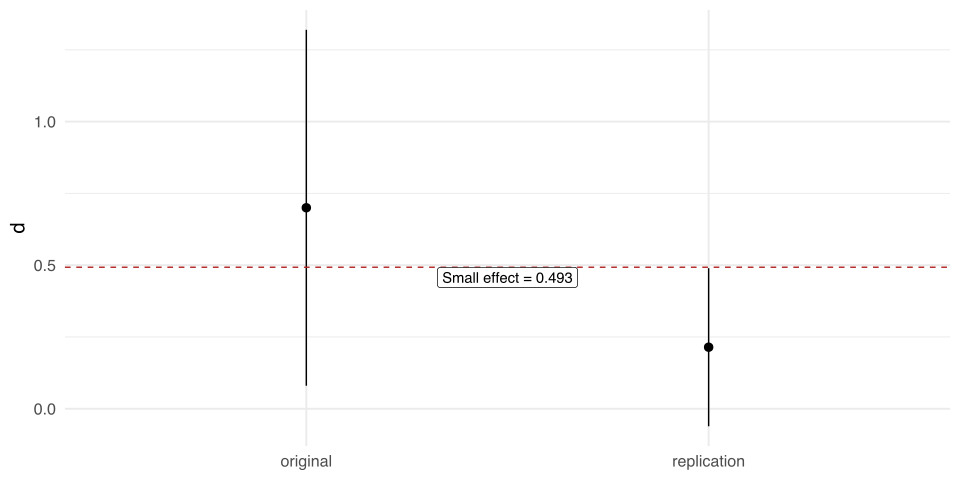
Original Study: d = 0.700 0.95 CI = [0.080, 1.320]
Replication Study: d = 0.214 0.95 CI = [-0.061, 0.490]
────────────────────────────────────────────────────────────────────────────────
The replicated effect is smaller than the small effect (0.493), no replication!

And a (quite over-killed) plot:
Bayesian Methods

Bayes Factor

Verhagen & Wagenmakers (2014) proposed a method to estimate the evidence of a replication study. The core topics to understand the method are:

Bayesian inference

Bayesian inference is the statistical procedure where prior beliefs about a phenomenon are combined, using the Bayes theorem, with evidence from data to obtain the posterior beliefs.

The interesting part is that the researcher express the prior beliefs in probabilistic terms. Then after collecting data, evidence from the experiment is combined increasing or decreasing the plausibility of prior beliefs.

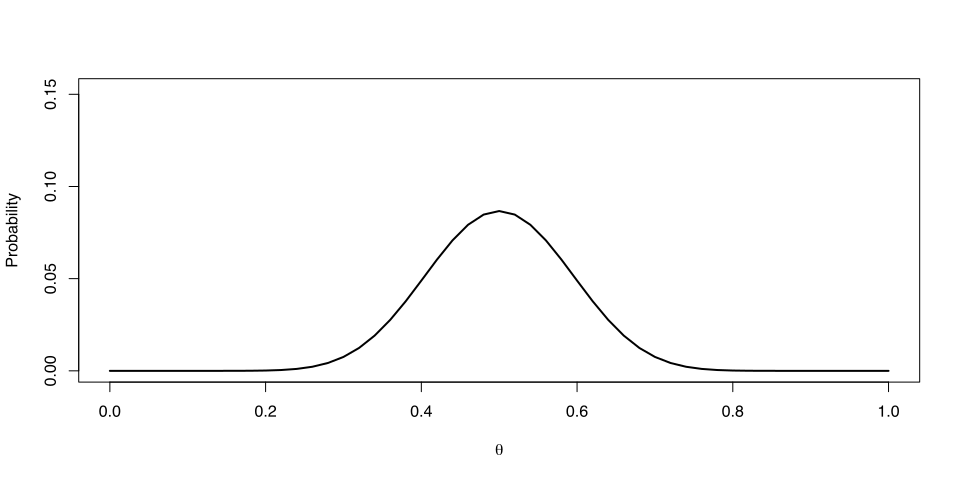
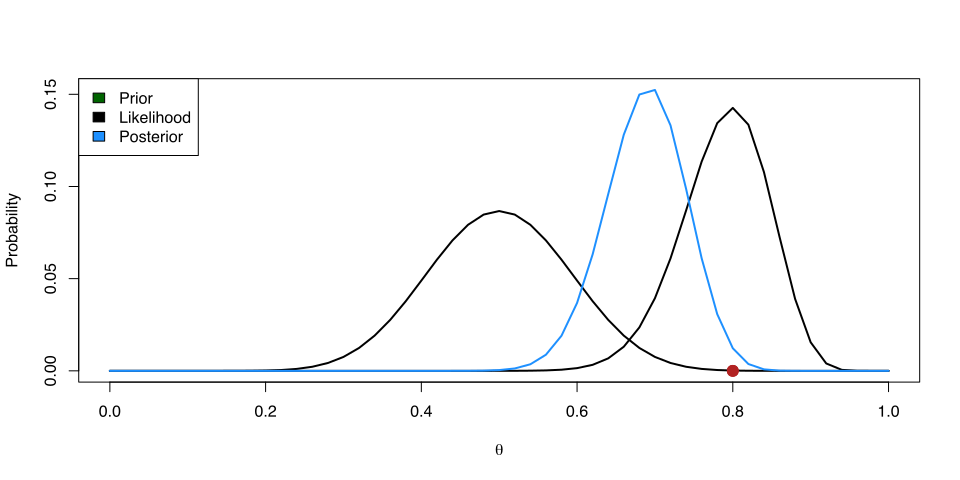
Let’s make an (not a very innovative 😄) example. We need to evaluate the fairness of a coin. The crucial parameter is \(\theta\) that is the probability of success (e.g., head). We have our prior belief about the coin (e.g., fair but with some uncertainty). We toss the coin \(k\) times and we observe \(x\) heads. What are my conclusions?

Bayesian inference

\[ p(\theta|D) = \frac{p(D|\theta) \; p(\theta)}{p(D)} \] Where \(\theta\) is our parameter and \(D\) the data. \(p(\theta|D)\) is the posterior distribution that is the product between the likelihood \(p(D|\theta)\) and the prior \(p(\theta)\). \(p(D)\) is the probability of the data (aka marginal likelihood) and is necessary only for the posterior to be a proper probability distribution.

We can “read” the formula as: The probability of the parameter given the data is the product between the likelihood of the data given the parameter and the prior probability of the parameter.

Bayesian inference

Let’s express our prior belief in probabilistic terms:
Bayesian inference

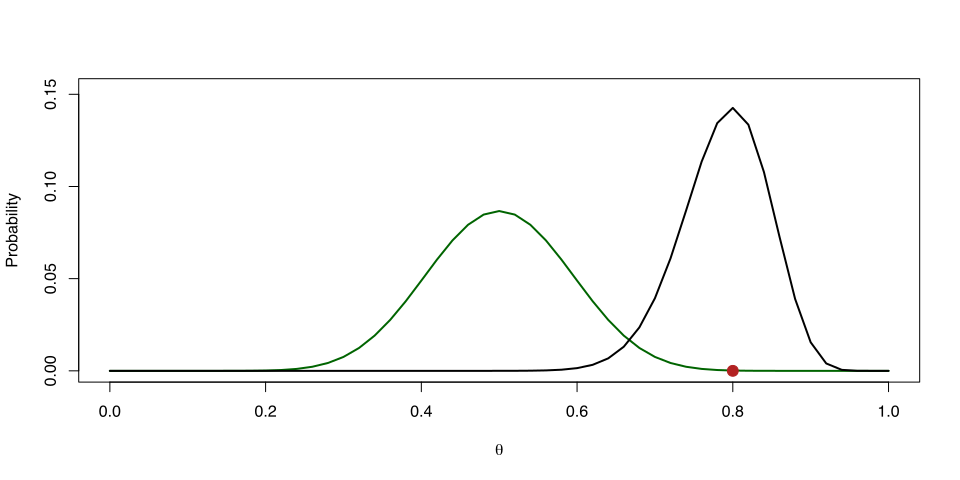
Now we collect data and we observe \(x = 40\) tails out of \(k = 50\) trials thus \(\hat{\theta} = 0.8\) and compute the likelihood:
Bayesian inference

Finally we combine, using the Bayes rule, prior and likelihood to obtain the posterior distribution:
Bayes Factor

The idea of the Bayes Factor is computing the evidence of the data under two competing hypotheses, \(H_0\) and \(H_1\) (~ \(\theta\) in our previous example):

\[ \frac{p(H_0|D)}{p(H_1|D)} = \frac{f(D|H_0)}{f(D|H_1)} \times \frac{p(H_0)}{p(H_1)} \]

Where \(f\) is the likelihood function, \(y\) are the data. The \(\frac{p(H_0)}{p(H_1)}\) is the prior odds of the two hypothesis. The Bayes Factor is the ratio between the likelihood of the data under the two hypotheses.

Bayes Factor using the SDR

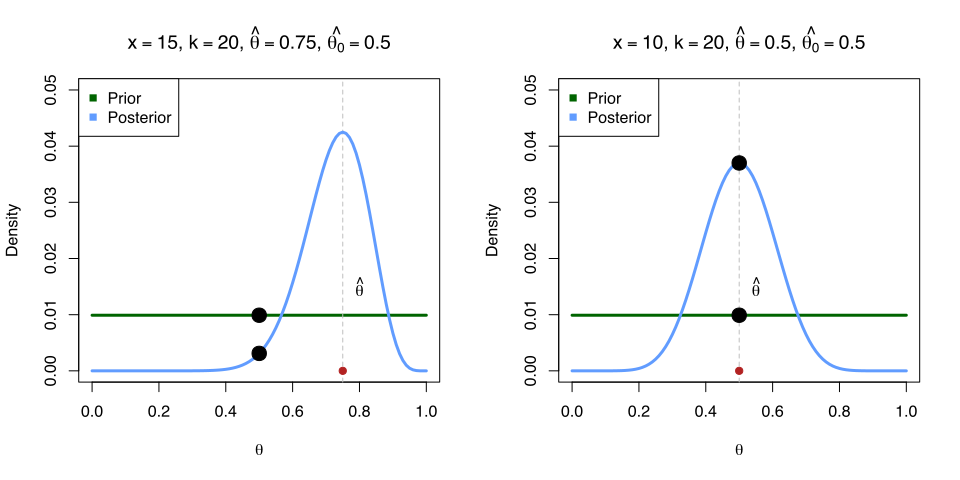
Calculating the BF can be problematic in some condition. The SDR is a convenient shortcut to calculate the Bayes Factor (Wagenmakers et al., 2010). The idea is that the ratio between the prior and posterior density distribution for the \(H_1\) is an estimate of the Bayes factor calculated in the standard way.

\[ BF_{01} = \frac{p(D|H_0)}{p(D|H_1)} = \frac{p(\theta = x|D, H_1)}{p(\theta = x, H_1)} \]

Where \(\theta\) is the parameter of interest and \(x\) is the null value under \(H_0\) e.g., 0. and \(D\) are the data.

Bayes Factor using the SDR, Example:

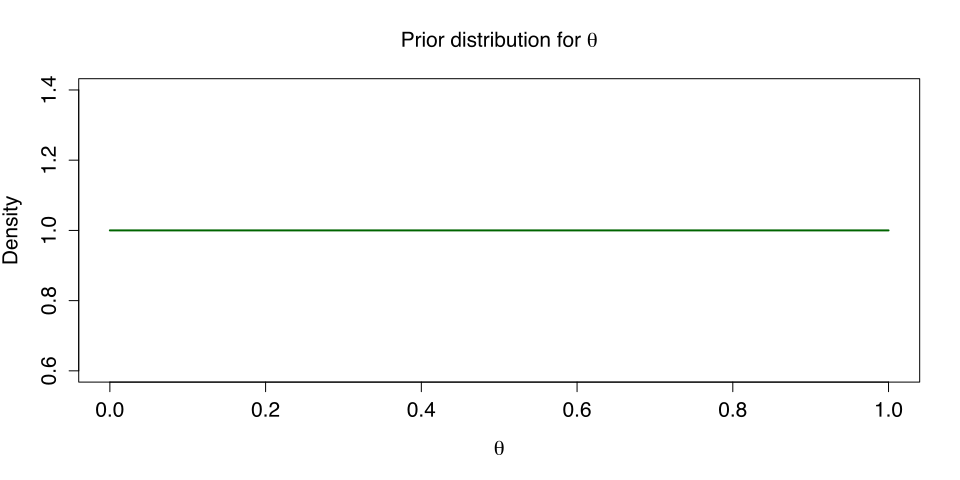
Following the previous example \(H_0: \theta = 0.5\). Under \(H_1\) we use a completely uninformative prior by setting \(\theta \sim Beta(1, 1)\).

We flip again the coin 20 times and we found that \(\hat \theta = 0.75\).
Bayes Factor using the SDR, Example:

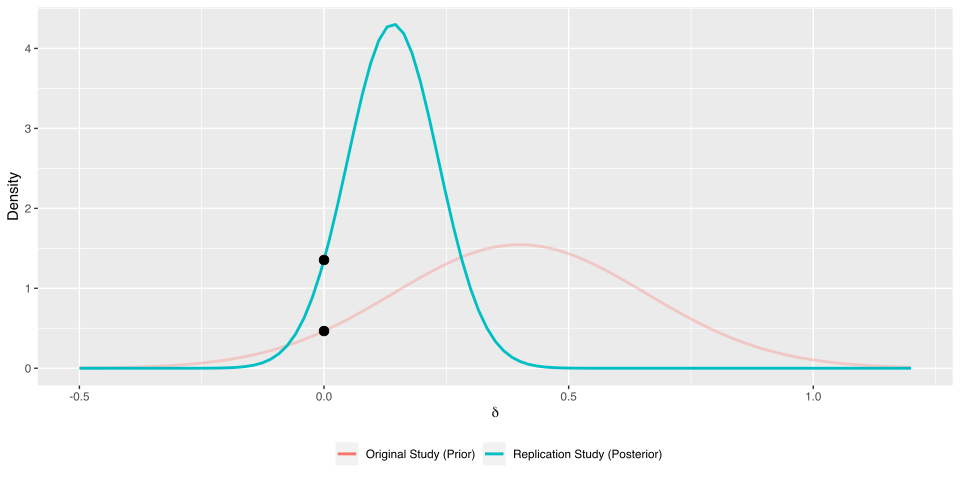
The ratio between the two black dots is the Bayes Factor.
Verhagen & Wagenmakers (2014) model1

The idea is using the posterior distribution of the original study as prior for a Bayesian hypothesis testing where:

  • \(H_0: \theta_{rep} = 0\) thus there is no effect in the replication study
  • \(H_1: \theta_{rep} \neq 0\) and in particular is distributed as \(\delta \sim \mathcal{N}(\theta_{orig}, \sigma^2_{orig})\) where \(\theta_{orig}\) and \(\sigma^2_{orig}\) are the mean and standard error of the original study

If \(H_0\) is more likely after seeing the data, there is evidence against the replication (i.e., \(BF_{r0} > 1\)) otherwise there is evidence for a successful replication (\(BF_{r1} > 1\)).

Verhagen & Wagenmakers (2014) model

Warning

Disclaimer: The actual implementation of Verhagen & Wagenmakers (2014) is different (they use the \(t\) statistics). The proposed implementation for the current workshop use a standard linear model.

Example

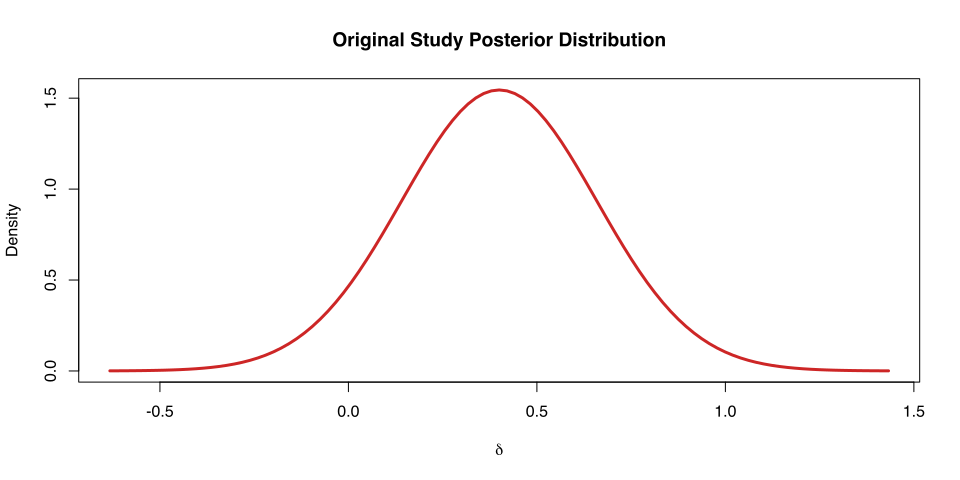
Let’s assume that the original study (\(n = 30\)) estimate a \(y_{orig} = 0.4\) and a standard error of \(\sigma^2/n\).

# original study
n <- 30
yorig <- 0.4
se <- sqrt(1/30)

Note

The assumption of Verhagen & Wagenmakers (2014) is that the original study performed a Bayesian analysis with a completely flat prior. Thus the confidence interval is the same as the Bayesian credible interval.

Example

For this reason, the posterior distribution of the original study can be approximated as:
Example

Let’s imagine that a new study tried to replicate the original one. They collected \(n = 100\) participants with the same protocol and found and effect of \(y_{rep} = 0.1\).
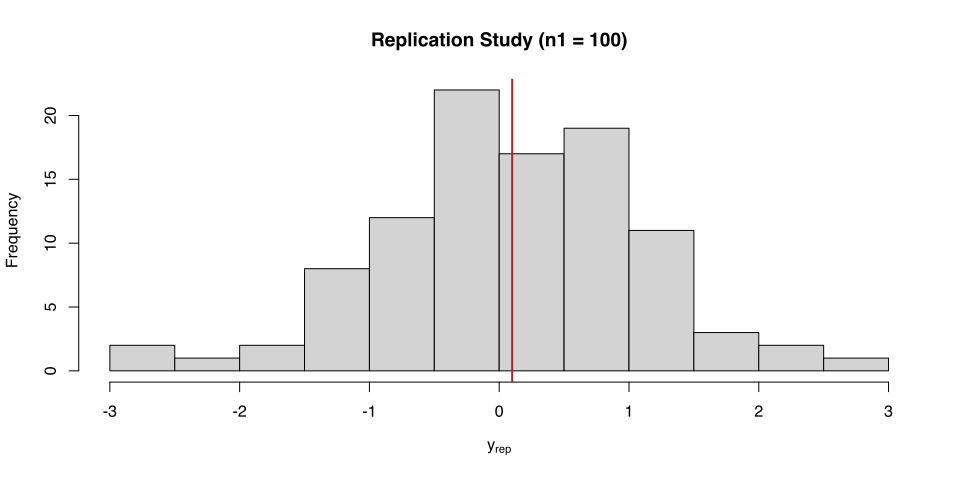
nrep <- 100
yrep <- MASS::mvrnorm(nrep, mu = 0.1, Sigma = 1, empirical = TRUE)[, 1]
dat <- data.frame(y = yrep)
hist(yrep, main = "Replication Study (n1 = 100)", xlab = latex2exp::TeX("$y_{rep}$"))
abline(v = mean(yrep), lwd = 2, col = "firebrick")

Example

We can analyze these data with an intercept-only regression model setting as prior the posterior distribution of the original study:

# setting the prior on the intercept parameter
prior <- rstanarm::normal(location = yorig,
                          scale = se)

# fitting the bayesian linear regression
fit <- stan_glm(y ~ 1, 
                data = dat, 
                prior_intercept = prior,
                refresh = FALSE)

summary(fit)

Model Info:
 function:     stan_glm
 family:       gaussian [identity]
 formula:      y ~ 1
 algorithm:    sampling
 sample:       4000 (posterior sample size)
 priors:       see help('prior_summary')
 observations: 100
 predictors:   1

Estimates:
              mean   sd   10%   50%   90%
(Intercept) 0.1    0.1  0.0   0.1   0.3  
sigma       1.0    0.1  0.9   1.0   1.1  

Fit Diagnostics:
           mean   sd   10%   50%   90%
mean_PPD 0.1    0.1  0.0   0.1   0.3  

The mean_ppd is the sample average posterior predictive distribution of the outcome variable (for details see help('summary.stanreg')).

MCMC diagnostics
              mcse Rhat n_eff
(Intercept)   0.0  1.0  2639 
sigma         0.0  1.0  2631 
mean_PPD      0.0  1.0  3447 
log-posterior 0.0  1.0  1615 

For each parameter, mcse is Monte Carlo standard error, n_eff is a crude measure of effective sample size, and Rhat is the potential scale reduction factor on split chains (at convergence Rhat=1).

Example

We can use the bayestestR::bayesfactor_pointnull() to calculate the BF using the Savage-Dickey density ratio.
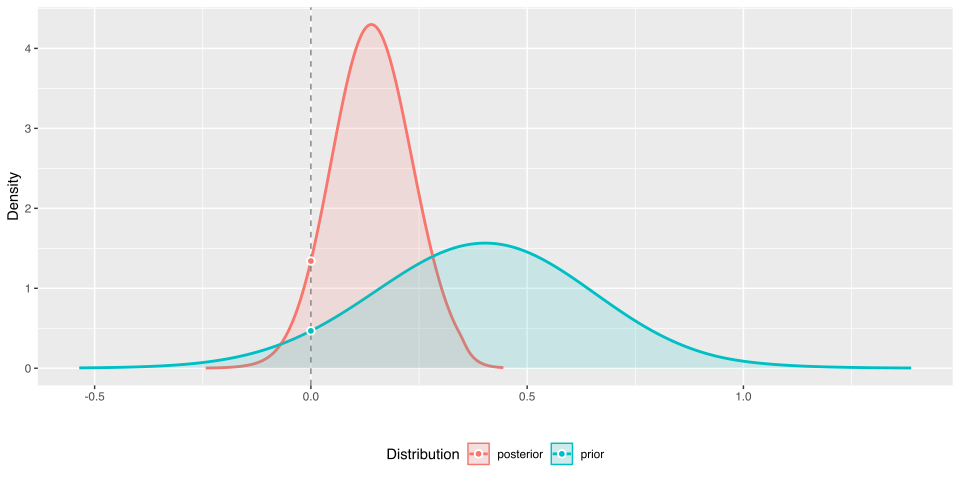
bf <- bayestestR::bayesfactor_pointnull(fit, null = 0)
print(bf)
Bayes Factor (Savage-Dickey density ratio) 

Parameter   |    BF
-------------------
(Intercept) | 0.348

* Evidence Against The Null: 0

plot(bf)

Example

You can also use the bf_replication() function:

bf_replication <- function(mu_original,
                           se_original,
                           replication){
  
  # prior based on the original study
  prior <- rstanarm::normal(location = mu_original, scale = se_original)
  
  # to dataframe
  replication <- data.frame(y = replication)
  
  fit <- rstanarm::stan_glm(y ~ 1,
                            data = replication,
                            prior_intercept = prior, 
                            refresh = 0) # avoid printing
  
  bf <- bayestestR::bayesfactor_pointnull(fit, null = 0, verbose = FALSE)
  
  title <- "Bayes Factor Replication Rate"
  posterior <- "Posterior Distribution ~ Mean: %.3f, SE: %.3f"
  replication <- "Evidence for replication: %3f (log %.3f)"
  non_replication <- "Evidence for non replication: %3f (log %.3f)"
  
  if(bf$log_BF > 0){
    replication <- cli::col_green(sprintf(replication, exp(bf$log_BF), bf$log_BF))
    non_replication <- sprintf(non_replication, 1/exp(bf$log_BF), -bf$log_BF)
  }else{
    replication <- sprintf(replication, exp(bf$log_BF), bf$log_BF)
    non_replication <- cli::col_red(sprintf(non_replication, 1/exp(bf$log_BF), -bf$log_BF))
  }
  
  outlist <- list(
    fit = fit,
    bf = bf
  )
  
  cat(
    cli::col_blue(title),
    cli::rule(),
    sprintf(posterior, fit$coefficients, fit$ses),
    "\n",
    replication,
    non_replication,
    sep = "\n"
  )
  
  invisible(outlist)
  
}

Example

bf_replication(mu_original = yorig, se_original = se, replication = yrep)
Bayes Factor Replication Rate
────────────────────────────────────────────────────────────────────────────────
Posterior Distribution ~ Mean: 0.137, SE: 0.097


Evidence for replication: 0.324652 (log -1.125)
Evidence for non replication: 3.080222 (log 1.125)

Example

A better custom plot:

bfplot <- data.frame(
  prior = rnorm(1e5, yorig, se),
  posterior = rnorm(1e5, fit$coefficients, fit$ses)
)
 
plt <- ggplot() +
  stat_function(geom = "line", 
                aes(color = "Original Study (Prior)"),
                linewidth = 1,
                alpha = 0.3,
                fun = dnorm, args = list(mean = yorig, sd = se)) +
  stat_function(geom = "line",
                linewidth = 1,
                aes(color = "Replication Study (Posterior)"),
                fun = dnorm, args = list(mean = fit$coefficients, sd = fit$ses)) +
  xlim(c(-0.5, 1.2)) +
  geom_point(aes(x = c(0, 0), y = c(dnorm(0, yorig, sd = se),
                                    dnorm(0, fit$coefficients, sd = fit$ses))),
             size = 3) +
  xlab(latex2exp::TeX("\\delta")) +
  ylab("Density") +
  theme(legend.position = "bottom",
        legend.title = element_blank())

Example

A better custom plot:

Exercises

Ego-Depletion and self-control Hagger et al. (2016)

Self-control has been regarded as an individual’s capacity to actively override or inhibit impulses; suppress urges; resist temptations; and break ingrained, well-learned behaviors or habits (Hagger et al., 2016).

  • Baumeister et al. (2007) proposed a limited-resource model of self-control

  • The ego-depletion effect is a behavioral effect where being engaged in a task requiring self-control reduce the strenght of self-control on a subsequent task (Baumeister et al., 2007).

Ego-Depletion and self-control Hagger et al. (2016)

  • Hagger et al. (2010) published a meta-analysis finding a standardized effect size of \(d = 0.62\) (\(SE = 0.02\), \(95\% CI = [0.57, 0.67]\)). They analyzed \(k = 198\) studies with a total of \(n = 10782\) participants.

  • However, Hagger et al. (2016) suggest that the effect could be inflated by publication bias and questioned the presence of the effect

  • Hagger et al. (2016) conducted a multi-lab replication study of the effect. See the OSF project https://osf.io/4zy8k/

Ego-Depletion and self-control Hagger et al. (2016)

The dataset can be found in 04-replication-methods/objects/hagger2016.rds:

       id m_exp sd_exp m_ctrl sd_ctrl n_exp n_ctrl           yi         vi
1       0    NA     NA     NA      NA    NA     NA  0.620000000 0.00040000
12   lab1 0.855  0.147  0.862   0.189    49     51 -0.040924886 0.04002438
19   lab2 0.904  0.153  0.896   0.141    62     58  0.053955545 0.03338254
110  lab3 0.888  0.207  0.849   0.239    50     49  0.173214156 0.04055969
13   lab4 0.857  0.177  0.864   0.198    75     71 -0.037138032 0.02742256
2    lab5 0.934  0.224  0.848   0.247    64     66  0.362328081 0.03128144
3    lab6 0.941  0.221  0.906   0.215    87     91  0.159900032 0.02255508
14   lab7 0.966  0.177  0.945   0.169   101    102  0.120915277 0.01974092
4    lab8 0.832  0.216  0.845   0.238    63     64 -0.056835612 0.03151073
15   lab9 1.000  0.192  0.956   0.180    50     52  0.234809077 0.03950104
5   lab10 0.855  0.271  0.922   0.244    79     80 -0.258679911 0.02536865
6   lab11 0.789  0.215  0.789   0.207    54     55  0.000000000 0.03670034
7   lab12 0.954  0.162  0.917   0.169    54     63  0.221687125 0.03460156
16  lab13 0.878  0.153  0.875   0.188    60     60  0.017391826 0.03333459
8   lab14 0.923  0.201  0.873   0.198    65     65  0.249147654 0.03100798
9   lab15 0.815  0.237  0.766   0.221    71     68  0.212507870 0.02895283
17  lab16 1.009  0.188  1.068   0.173    54     55 -0.324418361 0.03718312
18  lab17 0.881  0.173  0.919   0.182    48     50 -0.212226656 0.04106313
10  lab18 0.948  0.158  0.949   0.207    43     43 -0.005382076 0.04651180
11  lab19 0.943  0.223  0.885   0.219    47     49  0.260382433 0.04203788
20  lab20 0.948  0.185  0.898   0.188    53     52  0.266150985 0.03843601
21  lab21 0.908  0.204  0.916   0.200    59     56 -0.039328158 0.03481302
22  lab22 0.916  0.185  0.875   0.122    57     57  0.259891849 0.03538396
23  lab23 0.901  0.198  0.917   0.158    53     55 -0.088878058 0.03708631
24  lab24 0.896  0.174  0.860   0.184    99     99  0.200268475 0.02030330
           type
1      original
12  replication
19  replication
110 replication
13  replication
2   replication
3   replication
14  replication
4   replication
15  replication
5   replication
6   replication
7   replication
16  replication
8   replication
9   replication
17  replication
18  replication
10  replication
11  replication
20  replication
21  replication
22  replication
23  replication
24  replication

Ego-Depletion and self-control Hagger et al. (2016)

      id m_exp sd_exp m_ctrl sd_ctrl n_exp n_ctrl          yi         vi
1      0    NA     NA     NA      NA    NA     NA  0.62000000 0.00040000
12  lab1 0.855  0.147  0.862   0.189    49     51 -0.04092489 0.04002438
19  lab2 0.904  0.153  0.896   0.141    62     58  0.05395555 0.03338254
110 lab3 0.888  0.207  0.849   0.239    50     49  0.17321416 0.04055969
13  lab4 0.857  0.177  0.864   0.198    75     71 -0.03713803 0.02742256
2   lab5 0.934  0.224  0.848   0.247    64     66  0.36232808 0.03128144
           type
1      original
12  replication
19  replication
110 replication
13  replication
2   replication
  • the id is an identifier for the study. Note that 0 is the original meta-analysis while others are the multi-lab replication studies
  • *_exp and *_ctrl are the m mean, sd standard deviation and n sample size of the studies.
  • yi and vi are the effect size and the sampling variance of the studies

This is an interesting situation because we have a highly precise but probably biased original study and a probably unbiased multi-lab replications.

Gustatory Disgust on Moral Judgment Ghelfi et al. (2020)

  • Eskine and colleagues (2011) found that subjects who drank a bitter beverage before reading six moral vignettes judged the characters’ actions more harshly than did subjects who drank a sweet beverage or water.
  • The found an effect of \(d = 1.09\)1
  • Ghelfi et al. (2020) conducted a multi-lab study with \(k = 11\) laboratories

Gustatory Disgust on Moral Judgment Ghelfi et al. (2020)

The dataset 04-replication-methods/objects/ghelfi2020.rds contains the original study and the replications:


   id    m_exp    s_exp n_exp   m_ctrl    s_ctrl n_ctrl        type      yi 
1   0 78.34000 10.83000    15 61.58000 16.880000     21    original  1.1152 
2   1 75.28500 10.92395    20 65.36667 17.056364     19 replication  0.6822 
3   2 67.08341 11.11722    22 67.51758 12.487700     22 replication -0.0361 
4   3 62.25564 17.09394    19 64.25439 14.590814     19 replication -0.1231 
5   4 68.99107 11.93297    40 70.70188 15.700467     24 replication -0.1256 
6   5 76.52801 13.97302    17 76.64502 11.059971     22 replication -0.0092 
7   6 78.22348 11.95674     9 64.04607 20.920061      9 replication  0.7925 
8   7 67.02917 14.27363    24 65.93908 12.962434     29 replication  0.0791 
9   8 70.20217 11.27462    23 72.54924 12.626843     22 replication -0.1929 
10  9 70.19935 12.35952    51 71.70000 14.364429     55 replication -0.1109 
11 10 71.79252 14.64755   147 68.30610 13.783661    142 replication  0.2444 
12 11 70.20106 17.25785     9 64.76190  8.879799      8 replication  0.3691 
       vi 
1  0.1316 
2  0.1045 
3  0.0877 
4  0.1011 
5  0.0652 
6  0.1001 
7  0.2190 
8  0.0740 
9  0.0863 
10 0.0373 
11 0.0139 
12 0.2167 

Steps

  1. Choose one of the two datasets (or both)
  2. Load and explore the dataset
  3. Try to apply the methods explained in the slides. For one-to-one methods pick a random replication study or try the same method for each replication study
  4. Comment the results:
    1. Is there evidence for replication?
    2. Are there differences among replication methods?

References

Baumeister, R. F., Vohs, K. D., & Tice, D. M. (2007). The strength model of self-control. Curr. Dir. Psychol. Sci., 16, 351–355. https://doi.org/10.1111/j.1467-8721.2007.00534.x
Brandt, M. J., IJzerman, H., Dijksterhuis, A., Farach, F. J., Geller, J., Giner-Sorolla, R., Grange, J. A., Perugini, M., Spies, J. R., & Veer, A. van ’t. (2014). The replication recipe: What makes for a convincing replication? J. Exp. Soc. Psychol., 50, 217–224. https://doi.org/10.1016/j.jesp.2013.10.005
Bushman, B. J., & Wang, M. C. (2009). Vote-counting procedures in meta-analysis. In The handbook of research synthesis and meta-analysis (pp. 207–220). Russell Sage Foundation.
Eskine, K. J., Kacinik, N. A., & Prinz, J. J. (2011). A bad taste in the mouth: Gustatory disgust influences moral judgment: Gustatory disgust influences moral judgment. Psychol. Sci., 22, 295–299. https://doi.org/10.1177/0956797611398497
Ghelfi, E., Christopherson, C. D., Urry, H. L., Lenne, R. L., Legate, N., Ann Fischer, M., Wagemans, F. M. A., Wiggins, B., Barrett, T., Bornstein, M., Haan, B. de, Guberman, J., Issa, N., Kim, J., Na, E., O’Brien, J., Paulk, A., Peck, T., Sashihara, M., … Sullivan, D. (2020). Reexamining the effect of gustatory disgust on moral judgment: A multilab direct replication of eskine, kacinik, and prinz (2011). Advances in Methods and Practices in Psychological Science, 3, 3–23. https://doi.org/10.1177/2515245919881152
Hagger, M. S., Chatzisarantis, N. L. D., Alberts, H., Anggono, C. O., Batailler, C., Birt, A. R., Brand, R., Brandt, M. J., Brewer, G., Bruyneel, S., Calvillo, D. P., Campbell, W. K., Cannon, P. R., Carlucci, M., Carruth, N. P., Cheung, T., Crowell, A., De Ridder, D. T. D., Dewitte, S., … Zwienenberg, M. (2016). A multilab preregistered replication of the ego-depletion effect. Perspect. Psychol. Sci., 11, 546–573. https://doi.org/10.1177/1745691616652873
Hagger, M. S., Wood, C., Stiff, C., & Chatzisarantis, N. L. D. (2010). Ego depletion and the strength model of self-control: A meta-analysis. Psychol. Bull., 136, 495–525. https://doi.org/10.1037/a0019486
Hedges, L. V., & Olkin, I. (1980). Vote-counting methods in research synthesis. Psychol. Bull., 88, 359–369. https://doi.org/10.1037/0033-2909.88.2.359
Hedges, L. V., & Schauer, J. M. (2019a). Consistency of effects is important in replication: Rejoinder to mathur and VanderWeele (2019). Psychol. Methods, 24, 576–577. https://doi.org/10.1037/met0000237
Hedges, L. V., & Schauer, J. M. (2019b). More than one replication study is needed for unambiguous tests of replication. J. Educ. Behav. Stat., 44, 543–570. https://doi.org/10.3102/1076998619852953
Hedges, L. V., & Schauer, J. M. (2019c). Statistical analyses for studying replication: Meta-analytic perspectives. Psychol. Methods, 24, 557–570. https://doi.org/10.1037/met0000189
Hedges, L. V., & Schauer, J. M. (2021). The design of replication studies. J. R. Stat. Soc. Ser. A Stat. Soc., 184, 868–886. https://doi.org/10.1111/rssa.12688
Jeffreys, H. (1973). Scientific inference. Cambridge University Press.
Lakens, D., Scheel, A. M., & Isager, P. M. (2018). Equivalence testing for psychological research: A tutorial. Adv. Methods Pract. Psychol. Sci., 1, 259–269. https://doi.org/10.1177/2515245918770963
Ly, A., Etz, A., Marsman, M., & Wagenmakers, E.-J. (2019). Replication bayes factors from evidence updating. Behav. Res. Methods, 51, 2498–2508. https://doi.org/10.3758/s13428-018-1092-x
Mathur, M. B., & VanderWeele, T. J. (2019). Challenges and suggestions for defining replication "success" when effects may be heterogeneous: Comment on hedges and schauer (2019). Psychol. Methods, 24, 571–575. https://doi.org/10.1037/met0000223
Mathur, M. B., & VanderWeele, T. J. (2020). New statistical metrics for multisite replication projects. J. R. Stat. Soc. Ser. A Stat. Soc., 183, 1145–1166. https://doi.org/10.1111/rssa.12572
Nosek, B. A., & Errington, T. M. (2020). What is replication? PLoS Biol., 18, e3000691. https://doi.org/10.1371/journal.pbio.3000691
Patil, P., Peng, R. D., & Leek, J. T. (2016). What should researchers expect when they replicate studies? A statistical view of replicability in psychological science. Perspect. Psychol. Sci., 11, 539–544. https://doi.org/10.1177/1745691616646366
Rouder, J. N., Speckman, P. L., Sun, D., Morey, R. D., & Iverson, G. (2009). Bayesian t tests for accepting and rejecting the null hypothesis. Psychon. Bull. Rev., 16, 225–237. https://doi.org/10.3758/PBR.16.2.225
Schauer, J. M. (2022). Replicability and meta-analysis. In W. O’Donohue, A. Masuda, & S. Lilienfeld (Eds.), Avoiding questionable research practices in applied psychology (pp. 301–342). Springer International Publishing. https://doi.org/10.1007/978-3-031-04968-2_14
Schauer, J. M., & Hedges, L. V. (2020). Assessing heterogeneity and power in replications of psychological experiments. Psychol. Bull., 146, 701–719. https://doi.org/10.1037/bul0000232
Schauer, J. M., & Hedges, L. V. (2021). Reconsidering statistical methods for assessing replication. Psychol. Methods, 26, 127–139. https://doi.org/10.1037/met0000302
Schmidt, F. L., & Hunter, J. E. (2014). Methods of meta-analysis: Correcting error and bias in research findings (3rd ed.). SAGE Publications. https://doi.org/10.4135/9781483398105
Schmidt, S. (2009). Shall we really do it again? The powerful concept of replication is neglected in the social sciences. Rev. Gen. Psychol., 13, 90–100. https://doi.org/10.1037/a0015108
Simonsohn, U. (2015). Small telescopes: Detectability and the evaluation of replication results. Psychol. Sci., 26, 559–569. https://doi.org/10.1177/0956797614567341
Spence, J. R., & Stanley, D. J. (2016). Prediction interval: What to expect when you’re expecting … a replication. PLoS One, 11, e0162874. https://doi.org/10.1371/journal.pone.0162874
Valentine, J. C., Biglan, A., Boruch, R. F., Castro, F. G., Collins, L. M., Flay, B. R., Kellam, S., Mościcki, E. K., & Schinke, S. P. (2011). Replication in prevention science. Prev. Sci., 12, 103–117. https://doi.org/10.1007/s11121-011-0217-6
Verhagen, J., & Wagenmakers, E.-J. (2014). Bayesian tests to quantify the result of a replication attempt. J. Exp. Psychol. Gen., 143, 1457–1475. https://doi.org/10.1037/a0036731
Wagenmakers, E.-J., Lodewyckx, T., Kuriyal, H., & Grasman, R. (2010). Bayesian hypothesis testing for psychologists: A tutorial on the savage–dickey method. Cogn. Psychol., 60, 158–189. https://doi.org/10.1016/j.cogpsych.2009.12.001

  filippo.gambarota@unipd.it

  filippogambarota

  @fgambarota